Search

Cindy shares…

Ideas and the best of Baja!

Month

November 2015

Top-Selling GM Car In Mexico Has Huge Safety Flaws

One of General Motors Co.’s most popular cars in Mexico is putting the lives of its drivers at a huge risk.

The Chevrolet Aveo failed tests on adult occupant protection, according to a new rating issued Monday by the Latin America branch of the New Car Assessment Program, an independent group that evaluates the safety of consumer vehicles. The sedan, which was the best-selling car in Mexico from September 2013 until August of this year, is marketed without airbags in the country, placing adult occupants at high risk for life-threatening injuries if accidents occur.

Crash tests conducted by Latin NCAP found the car’s body shell to be unstable, with particularly poor protection for the driver’s chest and head. The Aveo received zero out of five possible stars for adult occupant protection.

Cars sold in Latin American markets are not held to the same safety standards as those sold in the United States and Europe. Many vehicles in Mexico are not required to have basic features like antilock braking systems or airbags, and their absence has been cited as a big factor in the rise of car-related deaths in the country.

The results of the Aveo’s recent safety test were so disturbing that Maria Fernanda Rodriguez, president of the Latin division of NCAP, wrote to GM CEO Mary Barra about the dearth of safety features in the automaker’s cars sold in Latin American markets.

“It is hard to understand how GM can still sell a non-airbag version of the Aveo in Mexico with a high fatality risk,” Rodriguez wrote.

The NCAP tested a European Aveo model nine years ago with slightly better results. The European version, with four airbags, received a two-star rating, which allowed it to to squeeze past the European Union’s regulatory tests. But those standards were discarded for models sold in Mexico.

The disparity underscores long-standing criticism that automakers lower safety standards for Latin American models in order to offset decreasing profits. A 2013 report by the NCAP found that cars by GM, Suzuki and Renault-Nissan tested significantly lower than their equivalent models in Europe and America, suggesting that the companies placed a higher value on the safety of customers there than those in developing countries.

“Government regulations in Latin America are softer than they are in the U.S. and Europe, and that allows manufacturers to sell cars with lower safety standards,” said Alejandro Furas, secretary general of Latin NCAP. “They also want to make as much profit as possible by removing certain features. We’ve seen less reinforcements in the structure, so less metal material, and no airbags.”

The NCAP is now calling for dramatic changes from GM, which just last year announced a sweeping effort to encourage employees to speak up if they notice potential safety issues in cars.

“All the measures we’re talking about have been developed in the last 20 years,” Furas said of GM’s safety features. “There’s no reason not to put them in the cars we have in Latin America.”

Earlier this year, Nissan backed away from its defense of its Datsun Go car as complying with Indian safety regulations. After receiving backlash for the model’s weak body shell and airbags, Nissan pledged to improve safety features. It’s an indication that car companies are gradually — though still somewhat reluctantly — starting to take concrete actions toward reducing the sale of potentially harmful vehicles in emerging markets.

GM did not immediately respond to a request for comment.
Winter celebrations in Mexico

In Mexico, Christmas is celebrated from the December 12th to January 6th.

From December 16th to Christmas Eve, children often perform the ‘Posada’ processions or Posadas. Posada is Spanish for Inn or Lodging. There are nine Posadas. These celebrate the part of the Christmas story where Joseph and Mary looked for somewhere to stay. For the Posadas, the outside of houses are decorated with evergreens, moss and paper lanterns.

In each Posada, children are given candles and a board, with painted clay figures of Mary riding on a donkey and Joseph, to process round the streets with. They call at the houses of friends and neighbors and sing a song at each home. The song they sing is about Joseph and Mary asking for a room in the house. But the children are told that there is no room in the house and that they must go away. Eventually they are told there is room and are welcomed in! When the children go into the house they say prayers of thanks and then they have a party with food, games and fireworks.

Each night a different house holds the Posada party. At the final Posada, on Christmas Eve, a manger and figures of shepherds are put on to the board. When the Posada house has been found, a baby Jesus is put into the manger and then families go to a midnight Church service. After the Church service there are more fireworks to celebrate the start of Christmas.

One game that is often played at Posada parties is piñata. A piñata is a decorated clay or papier-mâché jar filled with sweets and hung from the ceiling or tree branch. The piñata is often decorated something like a ball with seven peaks around it. The peaks or spikes represent the ‘seven deadly sins’. Piñata’s can also be in other forms. Children are blind-folded and take it in turns to hit the piñata with a stick until it splits open and the sweets pour out. Then the children rush to pick up as many sweets as they can!

As well as the posada’s, another type of Christmas play known as Pastorelas (The Shepherds). These tell the story of the shepherds going to find the baby Jesus and are often very funny. The devil tries to stop them by tempting them along the way. But the shepherds always get there in the end, often with the help of the Archangel Michael, who comes and beats the devil!

Nativity scenes, known as the ‘nacimiento’, are very popular in Mexico. The baby Jesus is normally added to the scene during the evening of Christmas Eve. The Three Kings are added at Epiphany.

Christmas Trees are becoming more popular in Mexico, but the main/most important decoration is still the nacimiento.

Christmas Eve is known as ‘Noche Buena’ and is a family day. People often take part in the final Posada and then in the evening have the main Christmas meal. At midnight, many people go to a Midnight Mass service, known as the ‘Misa de Gallo’ (Mass of the Rooster).

Poinsettia flowers are known as ‘nochebuena’ (Christmas Eve) flowers in Mexico.

People in Mexico also celebrate ‘los santos inocentes’ or ‘Day of the Innocent Saints’ on December 28th ad it’s very like April Fools Day in the UK and USA. 28th December is when people remember the babies that were killed on the orders of King Herod when he was trying to kill the baby Jesus.
In some states in Mexico children expect Santa Claus to come on December 24th. In the south of Mexico children expect presents on January 6th at Epiphany, which is known as ‘el Dia de los Reyes’.

It’s traditional to eat a special cake called ‘Rosca de Reyes’ (Three Kings Cake) on Epiphany. A figure of Baby Jesus is hidden inside the cake. Whoever has the baby Jesus in their piece of cake is the ‘Godparent’ of Jesus for that year.

Another important day, is Candelaria (also known as Candlemas) on the 2nd February and it marks the end of the Mexican Christmas celebrations. (http://www.whychristmas.com).

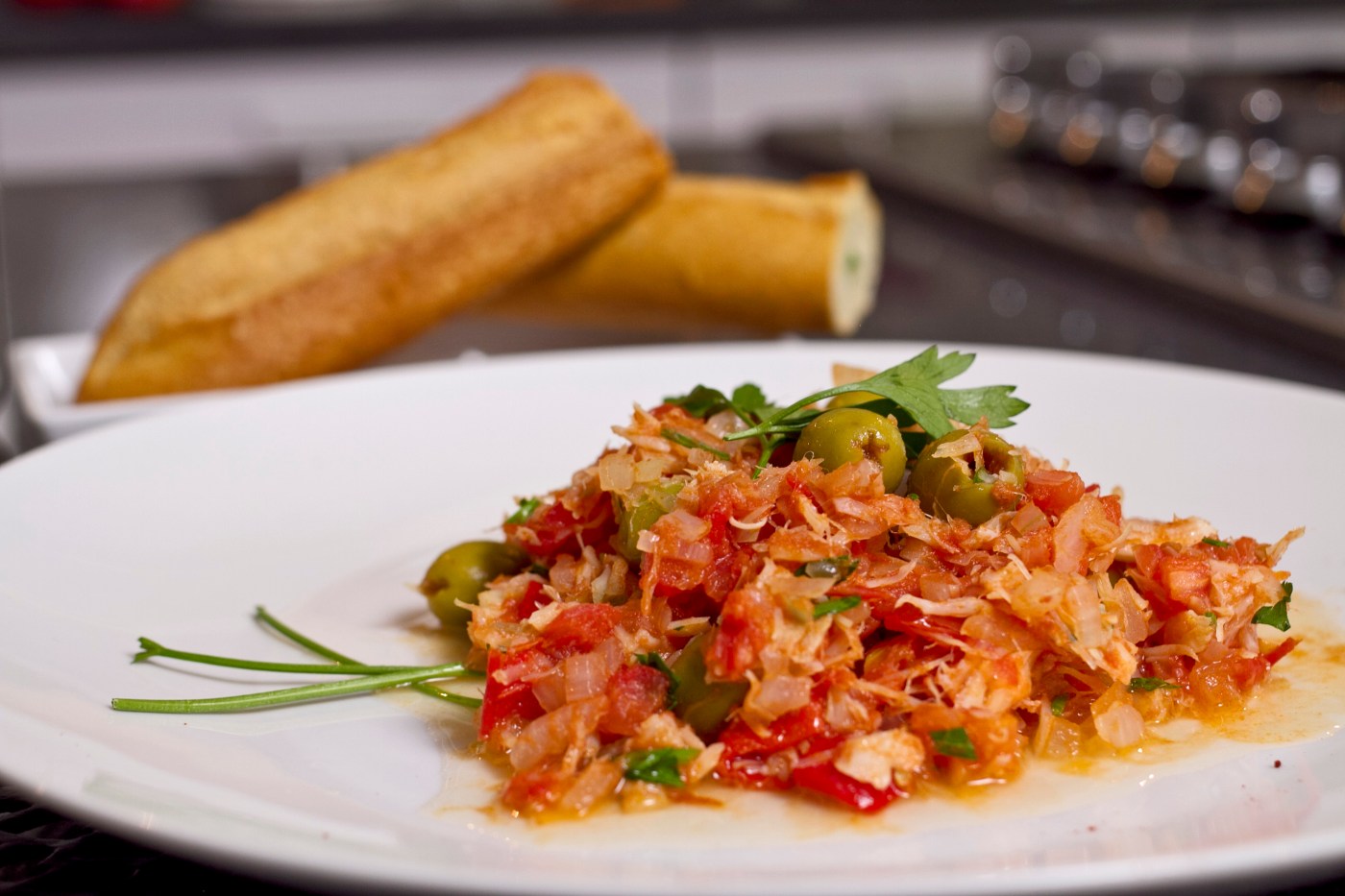
Mexican Style Salted Cod / Bacalao Mexicano a la Vizcaína

Salted cod is another traditional dish that’s very popular during Christmas time. It’s funny, but I actually didn’t care much for this dish growing up. I have vague memories as a kid of the grown ups in the family praising this dish and how exquisite the combination of flavors tasted. Now that I’ve grown up and tried it myself, though, I can see that they were right: this really is an exquisite dish. The image of the cod simmering with the roasted tomatoes, garlic, onions, olives, parsley, and raisins just makes my mouth water. Yes, I know, I’ve used that expression before, but I just can’t help it when I come across a really great recipe like this one.

Vizcaina Style Salted Cod originated in Spain, and was later adapted by Mexican cooks by adding more ingredients. Not only is salted cod a common dish for Christmas Eve Dinner, but the leftovers are used to make sandwiches (tortas) using French rolls the next day. It’ll actually taste better, since the flavors have had time to fully blend together.

The sauce for this recipe is very similar to the one for the Red Snapper Veracruz Style, just with some extra ingredients, like a variety of pickled peppers known as “Gueros” (very similar to banana peppers). I couldn’t find that particular type of pepper, so I used Pepperoncini peppers instead. Depending on where you live, you can also use Hungarian banana peppers or pickled jalapeños.

If you’re going to try this recipe out, make sure to make enough to have some left over, it tastes better the next day!

MAKES ABOUT 6-8 SERVINGS
INGREDIENTS:

  • 1 1/2 Salted Cod
  • 2 Lbs. Plum Tomatoes
  • 1/4 cup olive oil
  • 1 large onion, thinly sliced
  • 4 garlic cloves, minced
  • 1/3 cup raisins
  • 3/4 cup pitted olives
  • 2 Tablespoons capers, rinsed
  • 1-1/2 teaspoon dried Mexican oregano
  • 1 Lb new potatoes, cooked and peeled*
  • 4 Red peppers, roasted and cut into strips
  • 1 cup parsley, chopped
  • 6 Pickled Guero peppers  (banana, pepperoncinosi or jalapeños peppers will work fine)**
  • Salt and pepper to taste

DIRECTIONS:

  1. Rinse Salted Cod in water for at least 3 times until water comes out clean. As you can see on the top right picture, the water has a lot of salt floating in it. This was the first rinsing. After the 3rd rinse, the water is clear, as shown on the picture at the bottom left. Leave the fish to soak in this water for about 6-8 hours. It will be tender after the soaking time, as you can see on the bottom right picture
  2. Rinse and drain the fish again and place in a large stock pot with clean cold water. Gently simmer over a medium-high heat for about 7 minutes until it is tender. Drain fish and set aside, reserving some of the cooking liquid in case your sauce get dry and you need more liquid.
  3. While the fish is cooling, place tomatoes on a hot griddle to roast.
  4. Roasting the tomatoes will take about 10 minutes. If the fish is already cool enough to handle, shred it finely.
  5. Place roasted tomatoes into a blender and process until you have a smooth sauce. Strain using a sieve and set aside.
  6. Heat the olive oil in a large skillet over medium heat. Add the onion and cook until transparent, about 4 minutes, then stir in the garlic and cook for a couple more minutes. Add the roasted tomato puree and cook for about 5-7 minutes.
  7. As soon as the tomato sauce starts simmering, add the shredded Salted Cod. Stir and cook until the tomato sauce start simmering again, and, one by one, start slowly adding the raisins, olives, and capers. Allow the sauce to simmer and the flavors to blend.  Now, add the potatoes and keep simmering and stirring.
  8. Finally, add the roasted red pepper strips, freshly crumbled Mexican oregano, parsley, and pickled “Guero” peppers. Season with pepper and salt to taste. Remember that the fish was already salted, so be careful not to add salt before tasting the sauce. Keep simmering for about 10-15 more minutes or tomato sauce has reduced.
    http://www.mexicoinmykitchen.com/2014/12/mexican-style-salted-cod-bacalao-vizcaina-mexico.html

How to Make Lobster, Puerto Nuevo Style

Puerto Nuevo is a seaside village in Baja California, Mexico. It was made famous some 50 years ago for its succulent Pacific spiny lobster, which is renowned throughout Southern California.

Back in the old days, local fisherman would cruise up and down the shoreline in their pangas (fishing boats) and dive right off the rocks in search of the best lobsters.

The traditional Puerto Nuevo Lobster is deep fried in lard. They are pan-fried in the lard so the meat of the lobster stays tender and succulent. A good ‘ol Mexican beer or some ice cold coca-cola is a must with this dish. Of course don’t forget the beans, Spanish rice, limes, salsas, and only in Baja you can enjoy a delicious Lobster with rice and beans with a Sonora stile flour tortilla handmade your choice Tequila or beer either way …  Amazing!

Enjoy!, Cindy


INGREDIENTS

Servings: 6

6 large Mexican lobsters

2 cups lard or solid vegetable shortening

Old bay seasoning

Pepper

2 cups frijoles (beans)

2 cups spanish rice

Dozen or two of flour and/or corn tortillas

2 cups Salsa Fresca

2 cups Salsa Verde

PREPARATION

  • Bring a pot of water mixed with a little Mexican beer, to a boil. Throw in a bit of old bay seasoning.

  • Put the lobsters in for about 3 minutes. They won’t be thoroughly cooked.

  • Heat lard or vegetable shortening, in a heavy deep skillet.

  • Split the lobsters in half lengthwise and remove the green tamale inside.

  • Season the lobster halves with old bay seasoning and pepper.

  • Pan-fry each lobster halve for about 5 minutes on each side, until meat is tender and crisp.

  • Drain on paper towels.

  • You can serve them right away or place them in a warm oven until ready to serve.

Serve up your Puerto Nuevo Lobsters with frijoles, rice, tortillas, lime and salsas. You can eat the lobster either in a burrito or taco or just by themselves. Use the tortillas to scoop and mop up your beans, rice, excess pan juices and salsas – the Mexican way!

Blog at WordPress.com.

Up ↑